Reviews and ramblings about children's and young adult literature by an absentminded middle school librarian. I keep my blog to remember what I've read and to celebrate the wonderful world of children's and young adult literature.
Thursday, April 7, 2022
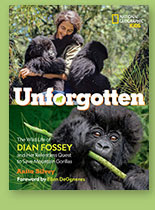
Fact Friday: Unforgotten: the Wild Life of Dian Fossey and Her Relentless Quest to Save Mountain Gorillas by Anita Silvey
Friday, January 21, 2022
Fact Friday: Vanishing: the World's Most Vulnerable Animals by Joel Sartore
Friday, January 7, 2022
Fact Friday: African Critters by Robert Haas
The bite-sized bits of information are fascinating, but the images are mesmerizing. Back matter includes an author's note, glossary, index, references and recommended reading of other Nat Geo titles. If you love animals, you will definitely want to check this book out.
Friday, June 25, 2021
Fact Friday: Wild Vet Adventures: saving animals around the world with Dr. Gabby Wild by Gabby Wild with Jennifer Szymanski.
Thursday, May 20, 2021
Fact Friday: Beneath the Waves: Celebrating the Ocean through Pictures, Poems and Stories by Stephanie Warren Drimmer
Beneath the Waves: Celebrating the Ocean through Pictures, Poems and Stories by Stephanie Warren Drimmer. 192 p. National Geographic, March, 2021. 9781426339165. (Review of finished copy borrowed from public library.)
Fact Friday features Beneath the Waves: Celebrating the Ocean through Pictures, Poems and Stories by Stephanie Warren Drimmer. This oversized is a handsome miscellanea of all things ocean. Well-organized and attractively designed, though not necessarily delivering on the promise of poems - there are six, leaving five of the eleven chapters without a poem. Nonetheless, the facts are fascinating, delivered in a combination of longer paragraphs as well as thumbnail boxes, and the photos are absolutely dazzling. The concluding chapter hammers home what we humans ought to be doing to protect the seas that surround us.
Back matter consists of an afterword by Sylvia Earle, a list of scientific names and an index, making it helpful for young researchers to locate specific information. If you display this prominently, it won't sit. That cover just begs readers!
I learned of this thanks to the blog "Randomly Reading." Pop on over there to read a more detailed and descriptive review.
Wednesday, November 27, 2019
Waiting on Wednesday: Breaking Through by Sue Macy
![]() |
| Image: National Geographic |
Breaking Through: how female athletes shattered stereotypes in the Roaring Twenties by Sue Macy. 96 p. National Geographic, February 4, 2020. 9781426336768.
Publisher synopsis: Award-winning author Sue Macy offers a fresh and timely account of women in sports in the 1920s, and how their determination, talent, and defiance in the face of criticism promoted women's rights, redefined femininity, and changed the course of history.
Macy offers a rare and fascinating glimpse into the journey of women's rights through the lens of women in sports during the pivotal decade of the 1920s. With elegant prose, poignant wit, and fascinating primary sources, Macy explores the many hurdles presented to female athletes as they stormed the field, stepped up to bat, and won the right to compete in sports. Featuring bold and talented heroines, this book documents how the social issues and morals of the decade--from politics to segregation to the media--helped shape the changing narratives around women and alter the course of history entirely. It is a fascinating window into a rich and seldom explored history, and also a topical reminder of the many discussions surrounding femininity and the role of women that continue today.
Friday, May 10, 2019
Fact Friday: Onward: A Photobiography of African-American Polar Explorer Matthew Henson by Dolores Johnson
![]() |
| Image: National Geographic/ Penguin Random House |
Onward: A Photobiography of African-American Polar Explorer Matthew Henson by Dolores Johnson. 64 p. National Geographic Photographer series. National Geographic Society, December, 2005. 9780792279143. (Review of finished purchased copy.)
Fact Friday features Onward: a photobiography of African-American Polar explorer Matthew Henson by Dolores Johnson.
On April 9, 1909, Commander Robert Peary took measurements that confirmed that he and his team had reached the North Pole. He thought he was the first explorer to do so until he returned to civilization and learned that Dr. Frederick Cook claimed he had done so a year earlier. Once the fraud was sorted out, Peary received credit for the achievement and his companion throughout nine attempts in the bitter cold, Matthew Henson received none.
Oh, brave white male explorers making names for themselves on the backs of the indigenous population! How courageous! (Is there a sarcasm font?) Think about any "explorer." Then, consider their "guides." Were they paid a fair wage or exploited and tossed aside?
It was Matthew Henson who got him there after eight failed attempts. Matthew Henson actually got to the pole first because he broke the trail; but it was Peary who measured the coordinates. Henson had innate talent. He didn't need tools. He used the stars and was often as accurate as Peary's instruments and calculations.
Imagine Peary's rage upon returning to find that Dr. Frederick Cook stole his thunder by claiming to plant a flag at the Pole earlier. The claim that was later proved false and Peary was acknowledged as the first. In fact, the National Geographic Society awarded Peary the Hubbard Medal in 1909. Was Matthew Henson given any credit? No. It wasn't until after Peary's death, that Henson received an award from Congress (1944) and the Navy Medal (1945). In 2001, he was posthumously awarded the Hubbard Medal.
This account sets the record straight with evocative writing and plentiful black and white archival photos, maps and pictures of diary entries. Back matter includes an afterword, chronology and bibliography and resources as well as quotation sources and an index.
Friday, August 3, 2018
Fact Friday: Stubby the War Dog: The true story about World War I's bravest dog by Ann Bausum
Stubby the War Dog: the true story about World War I's bravest dog by Ann Bausum. 80 p. National Geographic Society, May, 2014. 9781426314865. (Own)
I am a sucker for a good dog story, especially about dogs that serve. I also have a high interest in the first World War. And, I think Ann Bausum is a terrific writer! Win! Win! Win!
Stubby the War Dog is engaging and accessible, accompanied by many, well-captioned photographs. In a parallel story to Winnie, American soldier, Robert Conroy adopted a stubby-tailed stray while training to deploy overseas in WWI. He smuggled Stubby overseas where Stubby's keen senses proved valuable. Bausum's narrative weaves the story of the irrepressible Stubby with facts about the Great War, satisfying both fans of dogs and military history. I just loved this story. Share it with your students, and they will too!
Friday, June 1, 2018
Fact Friday: Ain't Nothing but a Man: my quest to find the real John Henry by Scott Reynolds Nelson and Marc Aronson
Ain't Nothing but a Man: my quest to find the real John Henry by Scott Reynolds Nelson and Marc Aronson. 64 p. National Geographic Society, December, 2007. 9781426300011. (Own)
Do you know the legend of John Henry? He was a steel-driving man of mythic proportions who laid tracks that would connect the eastern United States with the west. He has been immortalized in song, in a Disney cartoon and Caldecott Honor-winning picture book. But was he real? Historian Nelson recounts the story of his research into finding out in this beautifully designed informational picture book. Not only is the story of John Henry fascinating, this is an excellent portrayal of the work of a historian.
Wednesday, August 23, 2017
The Daily Booktalk: Waiting on Wednesday: Astronaut, Aquanaut: how space science and sea science interact by Jennifer Swanson
Astronaut, Aquanaut: how space science and sea science interact by Jennifer Swanson. National Geographic, January 9, 2017.
Publisher synopsis: Journey from the deepest trenches in the oceans to the farthest humans have ventured into space and learn what it takes to explore the extremes. You might just be surprised by how similar the domains of ASTRONAUTS and AQUANAUTS really are.
Space and the ocean. If you don't think they go together, think again! Both deep-sea and space explorers have to worry about pressure, temperature, climate, and most importantly, how to survive in a remote and hostile environment. Join us on an amazing journey as we go up in space with astronauts and dive deep down in the ocean with aquanauts to explore the far-off places of our planet and the solar system.
With a strong tie into STEM topics—such as making connections, making comparisons, and recognizing patterns across content areas—readers will discover the amazing science and incredible innovations that allow humans (and sometimes only machines) to survive in these harsh environments.
Jennifer Swanson's books are always interesting, timely and accessible.
Friday, August 11, 2017
The Daily Booktalk: Fact Friday: National Geographic Kids National Parks Guide U.S.A.
National Geographic Kids National Parks Guide U.S.A.: the most amazing sights, scenes & cool activities from coast to coast! 176 p. National Geographic Society, March, 2012. 9781426323140. (Review from copy borrowed from public library.)
It's Fact Friday folks! Today's feature is National Geographic Kids National Parks Guide U.S.A: the most amazing sights, scens & cool activities from coast to coast. I can't remember what prompted me to search the BCCLS catalog for National Parks earlier this summer, but I sure am glad I found this gem of a guidebook. As with any Nat Geo publication, it is beautifully designed, contains spectacular full-color photographs and is very kid-friendly. It was published to celebrate the 100th anniversary of the National Parks Services. President Theodore Roosevelt, aka The Conservation President wanted to preserve the beauty of wild places in the United States to ensure that generations of Americans could enjoy them. Roosevelt established 5 National Parks and 18 National Monuments before leaving office. Starting with Acadia National Park in Maine, readers will traverse the country, including Alaska and Hawai'i. Most of the parks get a four-page treatment, featuring maps, ranger tips, places for the best views, information about activities from relaxing to extreme and tidbits about the animals that make their homes in these protected place. But the National Parks Service is much more that wilderness preserves. Information about other National Parks Service preservation projects are scattered throughout the book, such as the USS Constitution in Boston, Ellis Island in New York, and the National Mall in Washington, D.C. The plentiful backmatter includes a list of National Park Properties by state or territory, a glossary, six websites for further information and an index. This guide is a wonderful way to learn about our national treasures, inspire road trips and, hopefully advocate for preservation.
I am purchasing this title for my own library as well as my school's library. While I have visited quite a few National Parks Service properties, the wilderness parks are places I'd like to explore some day.
Monday, June 6, 2016
Non-Fiction Monday: Everything Robotics by Jennifer Swanson
National Geographic Kids: Everything Robotics: all the robotic photos, facts and fun! by Jennifer Swanson. National Geographic Kids Everything series. 64 p. National Geographic, March, 2016. 9781426323324. (Review from purchased copy)
Oh, how I wish I had this back in the fall as I began "teaching" my school's very first robotics classes! STEM (though I prefer STEAM) is all the rage now and robotics is just plan fun. So is this book. Everything Robotics is absolutely a first purchase even if your school doesn't have a robotics course or club.
The bright yellow cover featuring a trumpet-playing white, vaguely Star Wars Stormtrooper-ish robot on the front and an "Ew!" inducing robot head stripped down to it's parts save the eyes and a pair of dentures, just screams, "You NEED to read me NOW!
Not only are there plenty of full-page, double-page and three-quarter-page spreads featuring crisp, full-color robots at work and play, but there are plenty of facts crammed into four chapters - Robots Rule!; Artificial Life; Robo-Helpers; and Fun with Robots. The field of robotics is exciting and cutting edge. The photos and information in this book convey that excitement. The information is well-organized, interesting and accessible.
There's a fun, "interactive" glossary (with page numbers provided as hints to the answers) as well as a "Find Out More" section with places to visit, books to read, movies to watch and websites. I have just put the MIT museum on my list for my next trip to Boston.
Monday, March 10, 2014
Non-Fiction Monday - Face to Face with Penguins
Face to Face with Penguins by Yva Momatiuk and John Eastcott. Face to Face series. 32 p. National Geographic Society, October, 2009. 9781426305610. (Review from purchased copy.)
I discovered this older title on a search for penguin books to fill a hole in my school's collection. It seems that penguins suddenly became popular as a subject for a fifth grade Polar regions report. Of course, the gorgeous cover drew my eye and beguiled. Then I noted that it was a National Geographic publication. Sold! I clicked the wanted button and waited for it to arrive.
While I waited, I wondered how I missed it. Later I learned that it is part of a series, so I checked out the eighteen titles and put a few in next year's book order. Sigh. After twelve-plus years of doing this, I still haven't found a foolproof system of keeping up.
Of course, penguins are rather high-interest animals that are quite photogenic. Of course, any Nat Geo publication is going to have spectacular photographs. But this slightly oversized, square book is most attractively designed from penguin-print motif endpage to endpage. I will call the two vibrant yellow of the endpages, Emperor penguin yellows. Very eye-catching!
The text is rather conversational and quite personal. The author describes her and her photographer husband's trip and their up-close and personal encounters with the penguins of South Georgia. One chapter asks the reader to imagine herself a penguin and is written in the second-person, which I personally do not care for. Still, young readers will most likely enthusiastically embrace the request.
There's plenty of white space and photographs on nearly every page in a variety of size from 3/4 spread to full-page to snapshot size. Penguin paw-print decorated text boxes provide extra information with engaging titles like, "What's the scoop on penguin poop. Pink poop means that the penguin's diet consists mostly of krill. Green is an ominous sign.
A chapter entitled Marine Sentinels warns of the effects of global warming on all polar life and includes suggestions that the reader can do to help reduce their family's carbon footprint. There's also a Facts at a Glance section for report writers, a glossary, suggestions for books, films and web sites to explore and an interesting note on the couple's research.
I believe this book will be a popular book for browsers and report writers alike.
Check out other Non-Fiction Monday posts at the Non-Fiction Monday blog.


