Showing posts with label 2013 reading. Show all posts

Sunday, October 8, 2017

SLJ Leadership Summit - Day 2

Saturday dawned cloudy and warm and rain was in the forecast; but the weather didn't matter because a long, full day was on tap.

Breakfast was self-serve and healthy - fruit, yogurts, I skipped the danish and grabbed a bran muffin. 

John Green was the keynote speaker. He has a new book, Turtles All the Way Down coming out next Tuesday and I sort of hoped that we'd get a copy; but there's an embargo on it so we all got a signed copy of Looking for Alaska, which turns ten this year! Yay! I will have to wait until Tuesday along with the rest of the world to read Turtles. His speech was funny, incisive and surprisingly emotional. I jotted a couple of quotes that resonated with me: I don't think the internet can fix the internet." 'Algorithms value clicks over nuance." And, "online tools jumpstart discussion, don't replace it."  


There was a panel called World Tour of Administrators: The literacy challenge and beyond. I didn't take any notes and am having trouble dredging up talking points. The only thing I wrote was, "Digital citizenship is not a lesson but a way of thinking and behaving and should be ongoing." A point I happen to agree with.

I chose Trust Me: media literacy for research as my first breakout session. This was pretty dynamic and very useful. I took tons of notes and both got some new ideas and feel that I'm on the right track with what I'm teaching this year.

The lunch buffet was grand as was the lunch keynote. Alan Miller spoke about The News Literacy Project. Lots of notes to follow up on there. 

The first afternoon panel was, Using Graphic Novels to Develop Racial Literacy. A high school librarian and language arts teacher brought four students to discuss how Gene Luen Yang's Printz Award winning book influenced them. Each student was incredibly articulate and thoughtful. I kept throwing quotes up on my FB feed. Totally bowled over, as was Gene. He kept saying that he couldn't add to what they said. One student, who identified as "not straight" and used or coined the term, overcompenstraight, was particularly thought-provoking. He asked for help "to completely be me." And used interesting similes and metaphors like the experience was like "reaching into a bucket of eels." He dislikes the term, micro-aggression, preferring instead, the term, macro-oppression. He claims this removes the dichotomy of aggressor and victim. Instead, he chooses to find a way to love the aggressor. Wow. 

The next panel was entitled: Visual Literacy; extending meaning through art and featured Cece Bell, Gareth Hinds and Javaka Steptoe. 


Panel moderator, Daryl Grabarek asked some interesting questions and each artist presented fascinating slides showing their process.

Authors were available to autograph their books following the conference. A cocktail reception followed featuring local authors signing their books and a strolling fiddler.

I piggybacked onto an invitation by Abdo books to dinner at Southern. The conversation was rambling and hilarious and the food was A-Mazing!


Several "pumpkin coaches" trotted by.


After dinner, we walked across the pedestrian bridge to burn some calories and take in the view.


All-in-all, a stupendous day.


Monday, November 7, 2016

Non-Fiction Monday: The Alphabet from the Sky by Benedikt Gross & Joey Lee


The Alphabet from the Sky by Benedikt Gross & Joey Lee. 64 p. Price Stern Sloan/ Penguin Random House, September, 2016. 9781101995815. (Review from copy borrowed from public library)

Even though alphabet books are usually catalogued and shelved in the picture book section, technically, they are part of languages and should be found in the 400s. Exceptions are always made to cater to the needs of each particular library. Alphabet concept books might be more likely found by a parent or child browsing the picture book section. Personally, I lean toward cataloging them all as 400 so that a patron might see the variety and scope of choices. I happen to collect alphabet books and while my home library is not strictly ordered by the Dewey Decimal System, I have all my alphabet books together on the shelf.

I am definitely adding this one to my home library and probably to my school's.

Who isn't fascinated by aerial views? When do we really have the opportunity for bird's eye views? Even if we fly frequently, the view out of the tiny porthole window of a plane is tiny and relatively fleeting. And, except for take off and landing, really too high to identify much. 

This book is the result of a Kickstarter campaign by the co-authors, who want to map the Earth's typography. Yes. Typography. That's no typo. Not topography. What letters do roads, buildings, rivers and landforms make?

The result of Gross and Lee's inquiry is this beautiful book. Other than the introduction, there are very few words in this book. Readers are invited to "read the landscape." Each double-page spread has the words, "Find the __" in the upper left hand side of the spread and a small yellow box containing the name of each town, state and latitude and longitude over a map of the US on which the town is located. There are many towns in Florida, two in New Jersey, several from Pennsylvania, a couple from Michigan and Illinois, several from California and Wisconsin, Georgia and Texas are represented with one.

Each photograph is crisp and colorful and startling in clarity. The first entry was photographed over Lake Work, Florida. The reader is asked to find the "A." It's easy enough but one is also distracted by possibilities for other letters. Indeed, the A is part of a neighborhood in which the streets also seem to form the letters, U, F, L, E, J, Y, M, B, O, Q and N. Upon closer inspection of the photo, the neighborhoods appear to float on water!

The children you share this with might want to rush through the book in the excitement of the scavenger hunt. You should let them; but leave time and an invitation to return to each spread to linger. Build inferencing skills by asking, "What do you see?" 

Our small group of readers had trouble finding the L. They consulted the handy answer key at the end. Of course! Why hadn't they seen it? The final four pages contain a series of slightly-larger-than-thumbnail photos of additional letters. 

This book was great fun and I can see its use in a variety of ways. I would've loved a bit more information about each spot, like what actually is that Q-shaped building? Then again, what better way to spur research than a mystery? 

Monday, December 30, 2013

Non-Fiction Monday: Wild Animal Neighbors: sharing our urban world by Ann Downer


64 p. Lerner/ Twenty-first Century Books, November, 2013. 9780761390213. (Borrowed from the public library)

I have to inject the personal right away because that I find that the cover alternately fascinates and repels me. I live in the suburbs, in a town that borders on a reservoir and boasts two golf courses, so there's plenty of wildlife to contend with. I regularly startle herds of deer while walking my dog at night. More creepily, three times in the last year, we've encountered coyotes, singly and in small packs, and luckily, from a distance. Still, I detour every time. There's something about them, as small as they are that scares me. I absolutely cannot imagine encountering one on a city street. (Shivers.)

And raccoons. Don't get me started. There's a very noisy family living in the hollow of a tulip tree in my side yard. Luckily, many years ago, my ingenious husband constructed a raccoon-proof garbage enclosure so I don't deal with shredded garbage all over the yard. I live across the street from the 18th hole of a golf course that is home to a huge pond, so they have water, and I'm sure there are plenty of neighbors with garbage that is more easily accessed.

Admittedly, these animals in my neighborhood are probably closer to wild than urban and, aside from using methods of deterrence, wouldn't dream of doing anything to harm them. It seems that many feel the same way as the non-migratory Canada geese in my town regularly cause traffic jams as they cross the street from the pond to graze on the grass on the island dividing our main drag. There's also a small flock (?) of turkey vultures that hang out in the vicinity and caused a massive traffic jam at a busy intersection nearby. I had to laugh when I learned that turkey vultures in south Jersey were read about by the author but didn't make the cut. There's a map of interesting urban animals around the world interested readers can research themselves. Web sites are provided.

I loved everything about this book from its conversational yet non-judgmental tone to its design. Seven animals are highlighted in short, attractively organized chapters featuring plenty of crisp, full-color photographs, well-placed text boxes and sidebars, an introduction, an epilogue, which explores ways of making cities more eco-friendly, and plentiful back matter. The only thing missing was a glossary which is a minor quibble since the neat vocabulary, such as plasticity and habitat fragmentation, are nicely defined within the text. Still, the teacher in me likes having a glossary of terms set apart for further reading.

I'm embarrassed to admit that I hadn't known about this book, despite its starred review in SLJ in October, until I spotted it in the new book display while browsing in my local library. It's going in my book order for school. Not only will it be of interest to browsers, but I think it will fit in nicely with a careers in science project the seventh grade science teacher and I collaborate on.

Lerner has links to some resources for teachers if you're willing to establish a user name and password.


Sunday, December 29, 2013

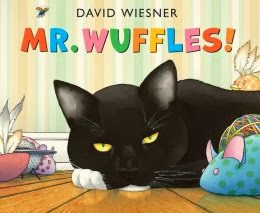
Mr. Wuffles by David Wiesner


32 p. Clarion/ Houghton Mifflin Harcourt, October, 2013. 9780618756612. (Borrowed from the public library.)

This is just brilliant - a wonderful confluence of realistic cat behavior and fantasy. Mr. Wuffles disdains a variety of cat toys laid out for his pleasure, most still sporting price tags save one metal structure reminiscent of two sieves mounted on a tripod. Five little green men peer out of the oblong window and begin to congratulate one another in a symbolic language until two cat's eyes appear in their window. They are suddenly upended. Mr. Wuffles has found a toy worthy of his attention!

Luckily, the five little green men are mostly unharmed, but their equipment is not. They decide that they must go in search of ... what? Not sure, but as they attempt to sneak behind Mr. Wuffles, they are discovered and surely lost, except a lady bug flies into Mr. Wuffles face, distracting him and allowing the aliens to escape underneath a nearby radiator, where they discover art on the walls reminiscent of cave paintings depicting the cat doing battle with insects. 

The aliens are then greeted by the insects, photos are taken, gifts are exchanged and, even though the languages are different, they manage to communicate. Mr. Wuffles remains standing guard outside, much to the bewilderment of his owner. The insects cull a pencil, a marble and an M & M from the detritus that has rolled underneath the radiator and the aliens find them useful for repairing the device that was broken. Now, to get past Mr. Wuffles. 

This gem will soon be added to the wordless collection at my school. It is a 2013 favorite. Will this win the author/ illustrator his fourth Caldecott or his second Honor? I love the author photo

Saturday, December 28, 2013

Five, Six, Seven, Nate by Tim Federle


293 p. Simon & Schuster Books for Young Readers, January 21, 2014. 9781442495890. (Review from arc courtesy of the author.)

This sequel/ companion to Better Nate Than Ever picks up on the eve of Nate's return to New York City to live with his Aunt Heidi while understudying the role of E.T. in E.T.: The Musical. He and his bff, Libby are singing show tunes and trying to write his bio for the Playbill. Libby shares some last minute advice and Nate impulsively does something, which surprises them both. (And me, as well.) Intermittently, Nate's dad bangs on the door to yell at Nate. Except for leaving Libby, Nate's not sorry to be leaving home. Nate is obsessed with Broadway. He knows when all the shows opened and closed, which were flops and can sing all the show tunes. One can see how Nate's a bit of an odd-man out having to grow up in a football-obsessed family in Pittsburgh. 

Once he arrives in the rehearsal space, he is deliriously happy to learn that there are three other shows rehearsing in the building as well. Then, he enters E.T., and is dismayed to find that everyone there seems to already know each other. Of course, he already knows someone, the show's star, Jordan Rylance, but Jordan and his mommy are staring daggers at him from across the room. Nate is further dismayed to learn that he is actually understudy to the understudy. That understudy is a tiny lady named Asella with twenty-five years in the business and no fondness for children. Then Nate is even further dismayed to learn that he needs to tap dance. Nate can't tap and finds himself reporting to rehearsals early for remedial classes. What is this? Middle school?

Well, sorta. There are cliques and rivalries and backstabbing. Nate finds himself in the wrong place at the wrong time several hilarious times and that gets him the wrong kind of attention. The times that he comes up with a brilliant idea and should get the right kind of attention, there is no applause. And the director can't get his name right. But Nate, my favorite optimist, puts a funny spin on each situation, tosses off hysterical asides, as well as dead on observations of adults behaving badly, and soldiers on.

Nate peppers his chronicles of the five weeks to first preview with all sorts of Broadway trivia, which should tickle readers who are theater geeks and entertain/ educate those who are not. As funny as this book is, the tone is more serious as Nate reveals how truly sad his home situation is. Aunt Heidi really is Nate's port in the storm. 

I read the final chapters blinking away tears but there were also many poignant moments throughout the book that made me wish I could reach into the story and give Nate a hug. 

Five, Six, Seven, Nate! can stand alone, but Nate is such a great character, I recommend that you start his journey at Better Nate Than Ever. I also hope that Nate shares more of his journey in a third book.

My students in grades five and six are in for a treat in late January as my school is one of Tim Federle's stops on his book tour. As soon as we get back to school, I will be busy booktalking and sharing snippets of videos, here and here. Visit the author's website here. Finally, teachers looking for a fun read-aloud that is also filled with discussion starters, there's a link to a Curriculum Guide linked to Common Core Standards here. 

This is a 2014 favorite. Yes, I know I read it in 2013, but you can't till 2014.

Friday, December 20, 2013

The 14 Fibs of Gregory K.


by Greg Pincus. 226 p. Arthur A. Levine Books/ Scholastic Inc., September, 2013. 9780439912990. (Finished copy courtesy of publisher for a review.)

Gregory K. is a poet lost in a family of math geniuses. Until now, amiable Gregory has kept his lack of math skills and fondness for the subject, a secret from his mathematically overachieving family. His cover is about to be blown because he's in danger of failing math. If he does, he knows he will find himself in math camp this summer instead of author camp with his best friend, Kelly. Author camp was always going to be a hard sell with his folks and now that Kelly's moving away, Gregory wants to attend more than anything. Can he risk telling his parents the truth? Remember I said that Gregory is amiable? In order to please everyone, he spins a series of lies. Of course, it collapses but Gregory gets help and support from an unexpected source and learns to see how his particular skill set can help him understand math.

This sweet and gentle middle grade novel about family, friendship, math and poetry is engaging and humorous. Warning: Do not read on an empty stomach. Kelly's mom owns a pie store named Slice, which Gregory visits daily and pie is described in glorious detail.

Thursday, December 19, 2013

Journey by Aaron Becker


unpgd. Candlewick Press, August, 2013. 9780763660536. (Finished copy courtesy of publisher for review.)

A lonely girl, ignored by family members involved with gadgets (nod to hello, hello by Matthew Cordell) finds a red crayon, and literally opens a door to a whole new world (Hello, Harold and the purple crayon.), which she floats through in a red row boat (shades of Tuesday by David Wiesner?).

Journey celebrates the power of the imagination in richly detailed art that begs long luxurious gazing. I love how the only color in the the girl's sepia-toned world were in her decidedly low-tech playthings, scooter, kite and ball. She also seems to have a true moral compass as she does not hesitate to rescue a caged purple bird heavily guarded by intimidating armored warriors. When the bird returns the favor, and the red crayon that was lost in the fray, the two plot escape on a red carpet. The bird shows the girl a purple door, through which she finds a boy with a purple crayon and a friendship is born. 


Journey was named a NYT Best Illustrated Book of 2013; it has shown up on quite a few additional year-end "Best" lists and I expect to see it come awards season. It's a 2013 favorite of mine. Journey would be a great addition to the wordless book collection.

Wednesday, December 18, 2013

Romeo and Juliet based on the play by William Shakespeare


Adapted and illustrated by Gareth Hinds. 132 p. Candlewick Press, September, 2013. 9780763668075. (PPB copy courtesy of publisher in return for a review.)

Gareth Hinds casts the Capulets and Montagues multiracially and takes a few liberties with the setting of Verona in this adaptation of Shakespeare's Romeo & Juliet. His abridgment maintains the Bard's iambic pentameter but he infuses some modern sensibility to both the art and the words. For example, Juliet rocks some really cool boots and a short dress for the party scene where they first meet. 

The art is gorgeous, the city is alive and vibrant, the night scenes are moody and dark, and the fight scenes crackle with energy and movement. The scene showing Romeo and Juliet dead in each other's arms is haunting and moving. 

An extensive author's note explains the decisions that were made in the book's production. Hinds' work is an automatic purchase for me. This volume is sure to lure your graphic novel fans into reading more Shakespeare.

Play Makers by Mike Lupica


(Game Changers #2) 201 p. Scholastic Press, February, 2013. 9780545381833. (Finished copy courtesy of publisher for review.)

"Just like that, it was basketball season." Within two weeks of winning the football championship, Ben finds himself facing a new rival at a pre-season basketball scrimmage. Chase Braggs seems to have all the moves and, what's more, seems to anticipate all of Ben's moves. Ben can respect that and is determined to work on his skills to get better, but Chase is cocky and confident and likes to strut his stuff. Ben lets this get under his skin, especially when Chase sets his sights on Lily, Ben's best friend.

Book #2 in this middle grade series can stand alone but Lupica's many middle grade fans will not want to miss any of it. Ben is a likable sixth grader and a consummate competitor. He's quite self-aware and analytical about most aspects of his life, but most especially the three sports he loves, football, basketball and baseball (#3, Heavy Hitters, due out in February, 2014). The dialogue flows smoothly and the sports action is brisk. Two small quibbles: First, Ben and Lily's friendship/ conversations sound a bit too old, like old married couple old. Second, Ben's a bit small for his age and the player on the cover and in the interior shots does not appear to be a small eleven-year-old. He's a bit too big, a bit too bulky for eleven.


Monday, December 16, 2013

The Ghosts of Tupelo Landing


by Sheila Turnage. 352 p. Kathy Dawson Books/ Penguin Group (USA)., February 4, 2014. 9780803736719. (Reviewed from a gifted arc)

Mo LeBeau and Dale Earnhardt Johnson III are back. They need to form a paranormal branch of The Desperado Detective Agency after Miss Lana finds herself the owner of a haunted inn. When their sixth grade teacher, Miss Retzyl, agrees to have her students interview Tupelo Landing's elder population to celebrate the town's 250th anniversary, Mo decides to interview the town's "oldest" resident, the inn's ghost, Nellie, much to Dale's horror.  

Readers of Turnage's Newbery Honor-winning debut, Three Times Lucky, will be thrilled to reunite with plucky, plain-spoken Mo, timid Dale, and all the quirky denizens of Tupelo Landing. I had a hard time not swallowing this one whole just as I did in Three Times Lucky (see review here). Lovely language, perfect pacing, and laugh-out-loud moments on nearly every page. Sure, there's a mystery to solve, but there are also secrets to uncover and a possible love interest for Mo? 

This sequel can stand alone, but encourage students to read both. They won't be disappointed and may, like me, hope that there will be more visits to Tupelo Landing.


Monday, December 2, 2013

Non-Fiction Monday: Discover More Weather by Penelope Arlon


80 p. Scholastic Inc., June, 2013. 9780545505161. (Finished copy courtesy of publisher.)

So far, I've been pleased with this new series from Scholastic and I had high hopes for this one since the sixth grade science teacher does a huge unit on weather each year. The series is dense with spectacular photos, and the photos certainly are the stars in this particular volume. 

This one seems aimed at a slightly lower age than the two I have already read. It starts off with a nice explanation of what weather is and moves on to explain the layers of the Earth's atmosphere, then moves on to discuss heat and wind. The next pages consist of an impressive double-page spread of the aurora borealis over Norway, then it's back to wind again. Huh? Why not place the aurora borealis a few pages later with the section on light tricks? The explanation of the various types of clouds was minimal. Then, it's on to precipitation, thunderstorms and lightning, where the factoids, while interesting, seem random and not useful to report writers looking for in-depth information. Still, I know browsers will eat this one up. If there's money in the budget, your browsers will thank you.

As I read some of the text boxes, such as the largest snowflake ever recorded being 15 inches wide in 1877, I wondered, says who, and flipped to the back for a list of sources. Alas, there's a page crammed with picture sources, a glossary and an index, but no sources or suggested further reading. 

Friday, November 29, 2013

Old School?

Last week, I trekked to a library in my cooperative that happened to have House of Hades available on audio. While I love ILL, when I have the time, I don't mind visiting other libraries to obtain the books I want. It gives me a chance to browse other collections, check out the layout, displays and ambiance. These three books happened to be displayed next to each other and my first thought was, "How old school are these?"


There was something about them that made me think of the early days of children's publishing when the palette was distinctly limited. I grabbed all three. Here's a round-up of reviews.


Once upon a Northern Night by Jean E. Pendziwol. Illustrated by Isabelle Arsenault. unpgd. Groundwood Books, July, 2013. 9781554981380. (Borrowed from the public library.)

In a perfect pairing of picture and text, Once upon a Northern Night is a terrific bedtime story for a cold winter's night, especially if snow is in the forecast. The repetition of the title in the first line of each new verse is lulling and the imagery is vivid. The mostly black and white paintings, depicting a variety of nocturnal animals in the snowy landscape caused me to wish for a blanket and is certain to cause a young listener to snuggle a little closer. Little pops of color, such as the last of the apples on a tree, the yellow eyes of an owl, and orange fox tail, draw the eye, though I could've done without the blush on the prancing rabbits, personally. Still, a lovely addition to any library. 


Lifetime: the amazing numbers in animal lives by Lola M. Schaefer. Illustrated by Christopher Silas Neal. 40 p. Chronicle Books LLC. September, 2014. 9781452107141. (Borrowed from public library.)

There's a bit more color in this intriguing and unique concept book than the cover implies, but the feel is definitely retro as each double-page spread depicts the behavior or event that is significant in each of the eleven animals depicted. "In one lifetime, this spider will spin 1 papery egg sac." Will young readers stop to count the 200 spots on a giraffe or the 550 eggs an alligator will lay over a lifetime? Not sure, but they are definitely countable.

Pages containing expanded information about each animal, including the scientific names and average life spans extend the age range for this cross-curricular picture book. Is this a science book or a math book or a book that shows that science and math are everywhere? A page explaining what an average is follows and the volume concludes with an author's note proclaiming her love of math and ending with two word problems.


How to Hide a Lion by Helen Stephens. 32 p. Henry Holt & Company Books for Young Readers, October, 2013. 9780805098341. (Borrowed from the public library.)

For some reason, this one made me think of the Lyle Crocodile books by Bernard Waber.


I couldn't find my own copy of the book and when I retrieved this cover image online, I wondered why I thought the two were similar. Perhaps it's the incongruity of the animals as pets?

All lion wants is a hat when he strolls into town on a hot day. Unfortunately, the townsfolk aren't welcoming. They chase him and he finds refuge in a play house belonging to a girl named Iris, who wasn't afraid of lions. She sneaks him into the house because, "moms and dads can be funny about having a lion in the house," and tends to the lion. Finding the perfect hiding place proves difficult since the lion is just, "too big, too fluffy, and too heavy."

Of course, after a bit, the jig is up and poor lion is on the run again. He finds a hiding place in the middle of town where no one, not even Iris notices him. When he notices and apprehends a pair of burglars stealing the mayor's candlesticks, the townsfolk are amazed and Iris gets to say, "I told you so." Lion gets a parade and the mayor tells him that he can have anything he wants. Can you guess what lion would like?

There's a lot more color in this one compared to the other two. Perhaps the retro feel I'm getting is from the sketch-like lines or the cartoonish, yet expressive face of the lion. Whatever, this is a delightful story to share one-on-one or as a read aloud for the pre-school and lower elementary grades. 

So, is the art trending backwards or are these three just an interesting coincidence?


Monday, November 25, 2013

Non-Fiction Monday: Eight Dolphins of Katrina: a true tale of survival


by Janet Wyman Coleman. Illustrated by Yan Nascimbene. unpgd. Houghton Mifflin Harcourt, August, 2013. 9780547719238. (Borrowed from public library.)

In the wake that was the devastation of Hurricane Katrina, this is the story of the improbable rescue of eight dolphins who were born in captivity but swept out into the Gulf of Mexico when a 40-foot wave destroyed their tank. The gorgeous photograph of two playful dolphins on the cover may cause one to expect a photo-essay. Indeed, I looked twice to see if this was a Scientist in the Field entry. Instead, watery paintings illustrate the story of storm preparations, disaster and recovery efforts. It's a short and gentle story for younger readers.

The second part of the book discusses instances where dolphins saved human life. An "exclusive" scrap book of the 
dolphins before and after their rescue concludes the volume.

It was nice to see how the trainers cared for and about the dolphins who, having been raised in captivity, had no survival skills for life in the wild. It was incredible that the dolphins found each other and stayed together in the Gulf. Just as incredible was their willingness to learn new tricks in order to assist in their rescue.

The illustrations fit the stories nicely. The photographs in the scrapbook were well-chosen. This real-life rescue story will appeal to animal lovers.

Non-fiction Monday is hosted this week by Jean Little Library.


Sunday, November 24, 2013

Numbed by David Lubar


143 p. Lerner Publishing Group, October, 2013.  9781467705943. (Borrowed from the public library)

Logan and Benedict are back. Logan is charged with keeping Benedict in line during a visit to a math museum. Benedict is immediately bored. wanders away from the class and discovers a door marked, "Closed to the Public." Of course, he enters, so Logan must as well. They encounter a friendly enough researcher named Dr. Thagoras, who is working on a robot that he introduces as Cypher. Cypher loves numbers and since Benedict does not, the two get into a bit of a tiff, which seems to short circuit the robot. While Dr. T is out of the room, Benedict decides to really let Cypher know what he thinks about math, so Cypher zaps the two boys. All the math they both have learned is gone. And there's a big math test in a few days!

Wordster Lubar proves he's equally adept at playing with numbers as he is playing with words. I really enjoyed Punished (2007) and chose to read it aloud to my middle grade classes then. I didn't blog about it because I hadn't started blogging yet. It was fun to revisit with Logan and Benedict though, as a math-phobe, I got a little numbed trying to follow the math in the book. Still, I'm passing this one on to the fifth grade math teachers as a read aloud suggestion. Why should LA teachers have all the fun/ responsibility of reading aloud? 

Give this one to students who want a short, funny read or students who love numbers. The book stands alone but be sure to check out Punished if you don't already know it.

Saturday, November 23, 2013

The Tortoise and the Hare by Jerry Pinkney


unpgd. Little, Brown and Company, October, 2013. 978031618567. (Purchased.)

Really, after five starred reviews from all the major professional review journals, what can I add that would be new, helpful or instructive? Nothing. Except my admiration for the artist whose creative output shows no sign of diminishing. And the world is a better place for it. Knock, knock, knock. Caldecott Committee? I do hope this is on the pile to be seriously discussed come January.

Mr. Pinkney returns to Aesop for inspiration and he sets the famous race in the American southwest. As he explains in the author note, The Tortoise and the Hare was a favorite of his growing up, especially as a dyslexic child, who had extra obstacles to overcome. He also explains his reason for setting the race in the southwest. Please do not skip reading the note when you read the book. And, please reread this nearly wordless wonder more than once. 

The mixed media, graphite watercolor, colored pencil, gouache and pastel illustrations beg to be read slowly. Pore over each page and pick out details you missed in earlier readings. Notice the slow unfolding of the moral of the fable on the pages featuring the tortoise. Notice the repetition and signatory red of the new word. Curl up with a beloved little one to share this. Share it with emerging readers. Share it with ESL students of any age. Share it in middle school LA and or art class. Share it. It's a keeper.

Friday, November 22, 2013

Paul Meets Bernadette by Rosy Lamb


unpgd. Candlewick Press, December 10, 2013. 978-0-7636-6130-4. (Review copy courtesy of publisher)

My first thought upon viewing the luscious cover of this debut picture book by artist/ sculptor Rosy Lamb, was of Tadpole's Promise, Jeanne Willis' 2008 sly masterpiece about star-crossed, inter-species love.
Bear with me now. Yes, the cover colors are similar and we've got the main characters gazing longingly at each other, but, clearly, the styles are quite different. But that's what popped into my head. That's my story and I'm sticking to it.

My next thought, after viewing the first few pages, was that this would be a rather typical story of friendship or love. You see, Paul's in a bit of a bowl-shaped rut. He spends his hours swimming in circles and the only variation on the routine seems to be the direction in which he is swimming. 

The oil paintings are spare and creamy with simple lines and smudges that imply movement. The colors are calming. There's really not much going on in Paul's world. Then Bernadette drops in and she immediately rocks it. This upheaval is reflected in the colors of the fish bowl as well as its size. Two fish are sharing the same small bowl, but it now it suddenly seems bigger and brighter. 

As Bernadette observes Paul's circular swimming, she asks, "Haven't you ever noticed that there's a whole world out there?" She points out a pair of bananas on a blue plate and asks what Paul thinks that yellow thing is. Paul mumbles non-commitally and Bernadette asserts that it is a boat. But she's not done. A vase of flowers is a forest, an alarm clock is a cactus and so on. Bernadette puts new meaning into the phrase, "Often wrong, but never in doubt." Even as she confidently corrects Paul when he identifies fried eggs. "Are you crazy?" says Bernadette..."That is the sun and the moon!"

That's it. Paul is smitten. "And you, Bernadette, are my star." A match made in heaven. I am smitten as well. This is a 2013 favorite. It's a book that makes me wish I had some younglings to read aloud to just to observe the expression on their faces as they get the jokes. It's a book that I'm buying for my own personal library. It's a book I'm buying as gifts for my teacher friends who teach lower elementary students.

PS: Be sure and take a look at the final painting on the back cover. I'm thinking that the art teacher at my school might have fun with this one too.

Monday, November 18, 2013

Non-Fiction Monday: Anubis Speaks! A guide to the Afterlfe by the Egyptian God of the Dead


by Vicky Alvear Shecter. Illustrated by Antoine Revoy. Secrets of the Ancient Gods series. 116 p. Boyds Mills Press, October, 2013. 9781590789957. (Finished copy courtesy of publisher.)

With much warning and caution about the possibility of being frightened and grossed out, first by the publisher, then by Anubis himself, the jackel-headed, snarky god of the dead guides us into the duat to begin our tour of the Underworld. Oops, Egyptian afterworld. He relates a brief overview of Egyptian history and the importance of the Nile river to Egyptian survival. Then, it's on to Ra's creation myth and the now indelible image of human-creation via Ra's giant loogies.

There's an awful lot of information packed into this slim volume as the reader travels through the twelve hours of Ra's nightly journey, filled, as promised with lots of gore and blood. A guide to the gods and demons, a glossary and extensive list of sources conclude the volume. The cover art is attention-grabbing but the interior black and white spreads are uneven, a few are a bit muddy, but most are serviceable, if a tad flat.

Of course, this begs pairing with Rick Riordan's Kane Chronicles. Kids who are curious about Egyptian mythology will find much to enjoy in Anubis Speaks!

I really enjoyed the author's biography of Cleopatra as well as her YA fiction, Cleopatra's Moon. Her knowledge of Egypt seems well-researched and encyclopedic, but more importantly, she can tell a darn good story. I am looking forward to the next installment in this series, Hades  Speaks. 

Author blog entry about the book.

Other blog reviews:
JeanLittleLibrary


Non-fiction Monday is hosted by NC Teacher Stuff today.

Sunday, November 17, 2013

Words with Wings by Nikki Grimes


84 p. Wordsong/ Boyds Mills Press, September, 2013. 9781590789858. (Finished copy courtesy of publisher)

Gabby is a daydreamer, like her father. She never knows what will send her tripping into her daydream world, but she finds refuge in it when her parents' fighting escalates. When they divorce and she and her mom move and she starts a new school, she finds she is happier there than where she should be:

To these kids,/ I'm not Gabby yet./ I'm just Shy Girl/ Who lives/ Inside Her Head.

Living with just her mother now seems to intensify the scrutiny, especially as Gabby realizes that being so much like her father probably displeases her mother.

Favorite Words

Mine: Pretend.
Mom's: Practical.
All we have in common
is the letter P.

Gabby likes her new teacher but is embarrassed about being called out about her daydreaming. So she puts them away and does her best to be in this world. Only it gets her down and after a while Mr. Spicer notices and asks to have his daydreamer back. He promises that if she try to focus during lessons, he will build some daydreaming time into class each day. It is this gift as well as the discovery of a like-minded potential friend that lifts Gabby's spirits.

Four weeks have passed/ and my notebook is thick/ with daydreams./ Funny how much better/ I'm doing in school./

Words with Wings is spare and lovely and filled with moving and poignant moments. It would make a perfect read-aloud in that it is rather brief but very powerful, apt to spark some interesting class discussion and/ or reflection, and could be used as inspiration for a writing unit.

Highly recommended. This is another 2013 favorite.