Showing posts with label women scientists. Show all posts

Thursday, April 7, 2022

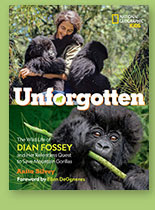
Fact Friday: Unforgotten: the Wild Life of Dian Fossey and Her Relentless Quest to Save Mountain Gorillas by Anita Silvey


Unforgotten: the Wild Life of Dian Fossey and Her Relentless Quest to Save Mountain Gorillas by Anita Silvey. 96 p. National Geographic Kids, June, 2021. 9781426371851. (Review of finished purchased copy.)

Happy Friday! Phew! This was a long one what with horrible sleeps and weird weather. I hope the weekend weather allows for lots of walks and gardening for me. 

Fact Friday features Unforgotten: the Wild Life of Dian Fossey and Her Relentless Quest to Save the Mountain Gorillas by Anita Silvey. This biography of the third and final member of the "Trimates," three female recruits of Louis Leakey, a famous paleoanthropologist who mentored them in their respective research fields - Jane Goodall studied chimpanzees, Biruté Mary Galdikas studied orangutans in Borneo and Dian Fossey studied gorillas. 

Dian Fossey was not a trained scientist. She was a physical therapist who worked in Louisville, Kentucky who had a lifelong dream to visit Africa. So she did. She spent all of her savings and borrowed money to trek to Africa for seven weeks. There, she fell in love with the Mountain Gorillas of the Democratic Republic of Congo (DRC). She also met Louis Leakey, who was impressed by her passion and intelligence. He raised money for her to return to DRC to set up camp and study the elusive primates. She spent the next 18 years doing so, first in DRC and then in neighboring Rwanda. She was fiercely protective of the gorillas and often clashed with poachers who set traps for the creatures.

Informative and well-organized, succinct text pair with amazing photographs and maps! The back matter is just terrific starting with field notes, mini-bios of eight of Fossey's gorillas, a timeline, a key to plants, books, articles, websites and film suggestions for further research, source notes, an endnote and an author's note add interest.

Friday, March 4, 2022

Fact Friday: Breaking Through the Clouds: the Sometimes Turbulent Life of Meteorologist Joanne Simpson


Breaking Through the Clouds: the Sometimes Turbulent Life of Meteorologist Joanne Simpson by Sandra Nickel and illustrated by Helena Perez Garcia. 48 p. Abrams Books for Young Readers, March 8, 2022. 9781419749568.

Happy Friday! Fact Friday celebrates Women's History Month and #nevertoooldforpicturebooks with Breaking Throught the Clouds: the Sometimes Turbulent Life of Meteorologist Joanne Simpson by Sandra Nickel and illustrated by Helena Perez Garcia. Any TMS sixth grader can tell you that one of my mottos is that one is never too old for picture books, especially if it is an informational one and especially if it is a biography. I cannot tell you how many times I was able to solve a crossword clue thanks to something I read in a book for young readers.

Joanne Simpson's fascination with clouds began at age five, when she took a small boat out behind the family cottage in Cape Cod to watch the clouds. By age ten, she was sailing solo in the ocean to escape her mother's harsh words for her. It seems that Joanne was "too stubborn and too smart" to be loved. So Joanne took solace in sailing and cloud watching. She was flying a plane by age sixteen and was able to get closer to her beloved clouds. She also kept notebooks. During WWII, while at the University of Chicago, she was asked to teach Air Force officers about clouds, but when the war ended and she wanted to continue her studies and earn a PhD, her professors laughed. She was a woman, and no women were meteorologist and she wanted to study clouds and clouds were just "currents of air filled with tiny beads of water..."

But Joanne persisted. She sold her boat to earn enough money to continue studying. She read. She studied. She watched the clouds and made calculations. She earned her PhD, but there were still obstacles ahead of her because she was a woman working in a "man's" field. All of her calculations were done using a slide rule, pencil and graph paper while her professor had a huge computer to work with. Eventually, this professor, who laughed at Joanne years earlier, recognized the importance of her models and offered her the use of his computer.

The palette in the gouache illustrations pop with vibrant color and add energy to this story of resiliency and perseverance. The end pages are decorated with all the different types of clouds. I appreciated the details embedded in the book cover, such as the weather map in the background and her flowing scarf. The pattern made me think of birds and of her love of flying. Back matter includes an author's note, three black and white photos of Dr. Simpson at work, a selected bibliography and a timeline.

This picture book releases next week. Budding meteorologists will want to learn about this important history, but it is history everyone should be aware of. Happy book birthday (in advance) to Breaking Through Clouds! Happy Women's History Month! Happy reading!

Friday, January 15, 2021

Fact Friday: Rachel Carson and Ecology for Kids: her life and ideas, with 21 activities and experiments by Rowena Rae

Rachel Carson and Ecology for Kids: her life and ideas, with 21 activities and experiments by Rowena Rae. 144 p. Chicago Review Press, February, 2020. (Review of e-book borrowed from public library.)


Happy Friday! We made it through another week! My students have a long weekend to look forward to. We teachers have a PD day on Monday.

Fact Friday features Rachel Carson and Ecology for Kids: her life and ideas with 21 activities and experiments by Rowena Rae. Rachel Carson was born in 1907 and was intensely curious about nature from her early years. Not only did she attend college when few women did, but she also studied science, specifically biology, which even fewer women did. She wrote eloquently about science and nature as well. Her intense observation and study of the natural world led her to the conclusion that pesticide use was adversely affecting animal life and the environment. She began to speak out against the use of pesticides in the 1950s and the 1962 publication of her book, Silent Spring, awakened the general public to these dangers to our environment.

This dual-use biography has activities and experiments that budding environmentalists can try. Although these activities were interesting - things like making bird seed cookies and building a worm farm, I found them intrusive to the flow of the narrative and would've preferred them to be grouped in a separate section, especially as they didn't directly connect to the text. There are plenty of photos to maintain interest and the back matter includes a timeline and glossary.

This biography serves as a fine introduction to the life and work of Rachel Carson.

Friday, December 11, 2020

Fact Friday: Eclipse Chaser: Science in the Moon's Shadow by Ilima Loomis


Eclipse Chaser: Science in the Moon's Shadow by Ilima Loomis with photographs by Amanda Cowan. 80 p. Houghton Mifflin Harcourt, December, 2019. 9781328770967. (Review of finished copy borrowed from public library.)

Happy Friday! Skies were clear last night, but I didn't see any sign of the aurora borealis. Bummer. Maybe some day. Let's turn our attention from the night sky to daylight. Fact Friday features Eclipse Chaser: Science in the Moon's Shadow by Ilima Loomis with photographs by Amanda Cowan. Many of you know of my love for the Scientist in the Field series. Each well-researched book highlights the work of a scientific specialty with vivid writing and spectacular photographs and this book is a worthy addition to any collection.

Shadia Habbal is an astronomer and solar physicist. She and her team travel the world in order to study solar eclipses. It's expensive to haul around the many computers, cameras and other equipment necessary to record eclipses. Sometimes the weather or other conditions do not cooperate. It might be too cloudy to see the eclipse or, in the case of one trip, wind kicked the desert sands up so much, visibility was decreased. Most of the book describes the team's work during the eclipse of August, 2017. Not only does Ms. Loomis vividly describe the actual eclipse, she also eloquently depicts the teamwork and collaboration on the part of the team.

There will be a full solar eclipse on December 14, but unless you're traveling to southern Africa, South America or Antarctica, you won't be able to view it. The next eclipse that will be viewable to those of us in North America will be on June 10, 2021. In the meanwhile, get your hands on this book to learn all about the work of the scientists who study the sun.

Friday, October 2, 2020

Fact Friday: Born Curious: 20 Girls Who Grew Up to be Awesome Scientists by Martha Freeman


Born Curious: 20 Girls Who Grew Up to be Awesome Scientists by Martha Freeman. 128 p. Paula Wiseman Books/ Simon & Schuster, February, 2020. 9781534421530. (Review of finished book borrowed from public library.)

Happy Friday TMS Readers! My did September fly right by! Here we are in October, the month of the Harvest Moon as well as a rare, Blue Moon on Halloween! Fact Friday features Born Curious: 20 Girls Who Grew Up to be Awesome Scientists by Martha Freeman. You all know that I am a fan of picture book biographies because a good one will give the reader a taste of a person's life and pique interest in learning more by perhaps reading a full-length biography. Collective biographies do so as well. A collective biography is, well, a collection of short biographies of individuals who share a theme. In this case, the author highlights twenty women, many you may not have heard of, who pursued their interest in science in a world that did not encourage women to do so. This diverse group of women came from a variety of backgrounds but all had a passion for science and all contributed to discoveries that made the world a better place. Born Curious is a fascinating, inspiring read.

Friday, August 17, 2018

Fact Friday: The Girl Who Drew Butterflies: how Maria Merian's art changed science by Joyce Sidman


The Girl Who Drew Butterflies: how Maria Merian's art changed science by Joyce Sidman. 240 p. Houghton Mifflin Harcourt, February, 2018. 9780544717138. (Review from purchased copy.)

Scientists in the late 1600s had little to no formal training and were nearly exclusively male. Indeed, a woman who expressed an interest in science and the natural world could be persecuted as a witch. Maria Merian's father died when she was three. Her mother then married an still life artist and young Maria was his assistant. He would send her into the garden to collect insects and inquisitive Maria would wonder where they came from. She also needed to learn skills from her mother about running a household. Still, she managed her chores for both parents and still found time to meticulously observe and record her insect collections. 

This informative biography is gorgeous in every way from its design through its illustration and writing. The book has heft. The cover and end-pages are lovely. Each page includes at least one illustration, whether Merian's art, engravings and other paintings from the time, maps or photographs. Each chapter is named for a phase in of insect development and there is a poem written by the author to introduce each chapter. 

Back-matter is extensive and includes a timeline, author's note, quote sources, a bibliography, suggestions for further reading, image credits and an index. 

Maria Merian's story is absolutely fascinating. This biography is a first-purchase for any library. 


Monday, January 6, 2014

Non-Fiction Monday: The Tree Lady: The True Story of How One Tree-Loving Woman Changed a City Forever


by H. Joseph Hopkins. Illustrated by Jill McElmurry. 32 p. Beach Lane Books, September, 2013. 9781442414020. (Borrowed from the public library.)

The cover of this picture book biography features an aerial view of a forest clearing and a little girl stretched out on her back contemplating the sky, presumably. Her dress is on the old-fashioned side and it is well and truly dirty. The jacket flap invites the reader to meet Kate Sessions.

Katherine Olivia Sessions grew up over a hundred years ago roaming freely in the woods of northern California. In the 1860s, little girls weren't supposed to get dirty, but Kate did. "But Kate did," is repeated at the end of each page and is an effective literary device to gently hammer home just how free-thinking she was. She excelled at science during a time when few women even showed interest in the subject. She grew up to study science at college and was the first woman to graduate from the University of California with a degree in science. She traveled south to San Diego, a place with few to no trees to teach school. After several years, she decided that she missed science and trees and set about planting trees in a park that served as a dump. She became a "tree hunter" and solicited gardeners from all over the world for seeds to trees that would grow in hot, dry weather. 

The story is simply and beautifully told and accompanied by lovely illustrations in a flat, folk art style that is utterly appealing. An author's note follows. 

This is an excellent addition to school libraries, including middle school. Let your science teachers know about it.