Showing posts with label biography. Show all posts

Wednesday, February 26, 2025

Waiting on Wednesday: Malcolm Lives by Ibram X. Kendi

Malcolm Lives: the Official Biography of Malcolm X for Young Readers by Ibram X. Kendi. 400p. Farrar, Straus and Giroux BYR. May 13, 2025.

I'm so excited for this biography. I'm a fan of Dr. Kendi. This news just inspired my #tbt post for tomorrow!

Publisher synopsis: In collaboration with the Malcolm X Estate, this powerful biography for young readers is a modern classic in the making, written by #1 New York Times-bestselling, National Book Award-winning author Ibram X. Kendi.

Published 100 years after his birth, Malcolm Lives! is a ground-breaking narrative biography of one of the most influential Americans of all time.

Dr. Kendi expertly crafts a propulsive telling of Malcolm X’s life—from birth to death. He provides context for both Malcolm’s choices—and those around him—not just painting an intimate picture of a famous figure, but of the social and political landscape of America during the civil rights movement.

Ultimately, Malcolm's true legacy is a journey toward anti-racism. Just like history, Malcolm lives.

With short, evocative chapters, exclusive archival documents, photographs from the Malcolm X Collection at the NYPL Schomburg Center, and extensive backmatter,this is a thoughtful and accessible, must-read for all Americans.

Thursday, April 7, 2022

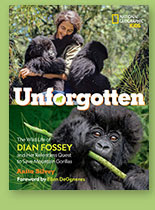
Fact Friday: Unforgotten: the Wild Life of Dian Fossey and Her Relentless Quest to Save Mountain Gorillas by Anita Silvey


Unforgotten: the Wild Life of Dian Fossey and Her Relentless Quest to Save Mountain Gorillas by Anita Silvey. 96 p. National Geographic Kids, June, 2021. 9781426371851. (Review of finished purchased copy.)

Happy Friday! Phew! This was a long one what with horrible sleeps and weird weather. I hope the weekend weather allows for lots of walks and gardening for me. 

Fact Friday features Unforgotten: the Wild Life of Dian Fossey and Her Relentless Quest to Save the Mountain Gorillas by Anita Silvey. This biography of the third and final member of the "Trimates," three female recruits of Louis Leakey, a famous paleoanthropologist who mentored them in their respective research fields - Jane Goodall studied chimpanzees, Biruté Mary Galdikas studied orangutans in Borneo and Dian Fossey studied gorillas. 

Dian Fossey was not a trained scientist. She was a physical therapist who worked in Louisville, Kentucky who had a lifelong dream to visit Africa. So she did. She spent all of her savings and borrowed money to trek to Africa for seven weeks. There, she fell in love with the Mountain Gorillas of the Democratic Republic of Congo (DRC). She also met Louis Leakey, who was impressed by her passion and intelligence. He raised money for her to return to DRC to set up camp and study the elusive primates. She spent the next 18 years doing so, first in DRC and then in neighboring Rwanda. She was fiercely protective of the gorillas and often clashed with poachers who set traps for the creatures.

Informative and well-organized, succinct text pair with amazing photographs and maps! The back matter is just terrific starting with field notes, mini-bios of eight of Fossey's gorillas, a timeline, a key to plants, books, articles, websites and film suggestions for further research, source notes, an endnote and an author's note add interest.

Saturday, September 11, 2021

Fact Friday: World of Glass: the Art of Dale Chihuly by Jan Greenberg and Sandra Jordan

World of Glass: the Art of Dale Chihuly by Jan Greenberg and Sandra Jordan. 64 p. Abrams Books for Young Readers, May, 2020. 9781419736810. (Review of finished copy borrowed from the public library.)

Happy Friday! Fact Friday features World of Glass: the Art of Dale Chihuly by Jan Greenberg and Sandra Jordan. If you're an artist, art lover or student of art history, you should never miss a biography written by these two collaborators. 

Dale Chihuly is a world-renowned glassblower. His innovative style and use of shapes and color make his glass sculptures singularly unique. The authors trace the artist's life from his childhood in Tacoma, Washington through the loss of both his brother and father, through college to his professional life. The text is accompanied by many striking color photos of the artist in action and his pieces.

World of Glass is a handsome addition to any library.

Friday, January 15, 2021

Fact Friday: Rachel Carson and Ecology for Kids: her life and ideas, with 21 activities and experiments by Rowena Rae

Rachel Carson and Ecology for Kids: her life and ideas, with 21 activities and experiments by Rowena Rae. 144 p. Chicago Review Press, February, 2020. (Review of e-book borrowed from public library.)


Happy Friday! We made it through another week! My students have a long weekend to look forward to. We teachers have a PD day on Monday.

Fact Friday features Rachel Carson and Ecology for Kids: her life and ideas with 21 activities and experiments by Rowena Rae. Rachel Carson was born in 1907 and was intensely curious about nature from her early years. Not only did she attend college when few women did, but she also studied science, specifically biology, which even fewer women did. She wrote eloquently about science and nature as well. Her intense observation and study of the natural world led her to the conclusion that pesticide use was adversely affecting animal life and the environment. She began to speak out against the use of pesticides in the 1950s and the 1962 publication of her book, Silent Spring, awakened the general public to these dangers to our environment.

This dual-use biography has activities and experiments that budding environmentalists can try. Although these activities were interesting - things like making bird seed cookies and building a worm farm, I found them intrusive to the flow of the narrative and would've preferred them to be grouped in a separate section, especially as they didn't directly connect to the text. There are plenty of photos to maintain interest and the back matter includes a timeline and glossary.

This biography serves as a fine introduction to the life and work of Rachel Carson.

Friday, September 11, 2020

Fact Friday: The Red Bandanna by Tom Rinaldi

Image: Penguin Random House

The Red Bandanna (Young Readers Adaptation) by Tom Rinaldi. 176 p. Penguin Young Readers Group, September, 2017. (Own)

Fact Friday is featuring an older title to acknowledge the 19th anniversary of the terrorist attacks of September 11, 2001. The Red Bandanna (Young Readers Adaptation) by Tom Rinaldi is the biography of Welles Crowther. On September 11, he was working on the 104th floor of the World Trade Center when the planes hit below his floor. He never came home. His parents grieved not knowing what happened. Then, his mom read an article where survivors spoke of a man in a red bandanna as their rescuer and Mrs. Crowther knew that was her son, Welles. He always carried a red bandanna in his pocket. It was his emblem ever since receiving one from his dad when he was 8 or 9. He was one of the many heroes of 9/11. 

Mr. Rinaldi produced a short film about Welles Crowther for ESPN, then wrote a biography for adults. This adaptation for young readers is an emotional read; but a beautiful tribute to a young man who made a choice to go back into a burning building to help.

Friday, April 3, 2020

Fact Friday: Her Own Two Feet: a Rwandan girl's brave fight to walk by Meredith Davis and Rebecca Uwitonze

Image: Scholastic
Her Own Two Feet: a Rwandan girl's brave fight to walk by Meredith Davis and Rebecca Uwitonze. 199 p. Scholastic Focus/ Scholastic Inc., October, 2019. 9781338356373. (Review of finished copy courtesy of publisher.)

Fact Friday features Her Own Two Feet: a Rwandan girl's brave fight to walk by Meredith Davis and Rebecca Uwitonze.  Maybe you're feeling a bit sorry for yourself now that we've spent three weeks in virtual school and remaining isolated from friends. At least we're all in this together; fighting for a common cause - to flatten the curve. Reading this book sure did put things into perspective for me. 

Rebeka Uwitonze was born with club feet. Her feet were so twisted that doctors feared she would never walk and the people in her village told her parents to abandon her by the side of the road. As she grew, villagers avoided her, spat on her and called her cursed. Her parents did not abandon her and did everything they could to support Rebeka. She was loved. But she was also growing and was becoming too heavy for her mother to carry. Rebeka's condition was fixable at birth -in a developed country like the U.S. In Rwanda, her parents lived far from a hospital and were too poor to afford that kind of care. 

When Rebeka was nine, she was sponsored by an American doctor to travel to the U.S. to be evaluated for surgery to repair her feet. She lived in Austen, Texas with the Davis family, who took care of her while she endured many painful surgeries. She missed her family. She spoke almost no English; but she was resilient. Her parents' motto, "Amahirwe aza rimwe," "chance comes once," became her mantra. Her photo-filled story touches the heartstrings. Her Own Two Feet was just the right story I needed at this time. I am in awe of Rebeka and you will be too. Read it.

Friday, June 21, 2019

Fact Friday: Library on Wheels: Mary Lemist Titcomb and America's first bookmobile by Sharlee Glenn

Image: Abrams
Library on Wheels: Mary Lemist Titcomb and America's first bookmobile by Sharlee Glenn. 52 p. Abrams Books for Young Readers, April, 2018. 978141972875. (Review of finished purchased copy.)

The last Fact Friday of the school year features Library on Wheels: Mary Lemist Titcomb and America's first bookmobile by Sharlee Glenn. This is a book that warms my librarian heart. 

There weren't many career opportunities for women in the late 1800s. Indeed, most women were not encouraged to even obtain an education let alone a job. But Mary Lemist Titcomb insisted upon an education and ultimately trained to become a librarian, eventually working her way up to chief librarian. That was not enough, she identified a need - poor residents in the rural communities did not have access to books or libraries. She put together a mobile library on a horse-drawn carriage to bring the books to that community. 

The design of the book is absolutely gorgeous. Filled with fascinating vintage black and white photos and ephemera. Twelve pages of back matter attest to the research, love and care that went into this beautiful biography. This book begs to be read slowly. 

Friday, May 10, 2019

Fact Friday: Onward: A Photobiography of African-American Polar Explorer Matthew Henson by Dolores Johnson

Image: National Geographic/ Penguin Random House

Onward: A Photobiography of African-American Polar Explorer Matthew Henson by Dolores Johnson. 64 p. National Geographic Photographer series. National Geographic Society, December, 2005. 9780792279143. (Review of finished purchased copy.)

Fact Friday features Onward: a photobiography of African-American Polar explorer Matthew Henson by Dolores Johnson. 

On April 9, 1909, Commander Robert Peary took measurements that confirmed that he and his team had reached the North Pole. He thought he was the first explorer to do so until he returned to civilization and learned that Dr. Frederick Cook claimed he had done so a year earlier. Once the fraud was sorted out, Peary received credit for the achievement and his companion throughout nine attempts in the bitter cold, Matthew Henson received none.

Oh, brave white male explorers making names for themselves on the backs of the indigenous population! How courageous! (Is there a sarcasm font?) Think about any "explorer." Then, consider their "guides." Were they paid a fair wage or exploited and tossed aside? 

It was Matthew Henson who got him there after eight failed attempts. Matthew Henson actually got to the pole first because he broke the trail; but it was Peary who measured the coordinates. Henson had innate talent. He didn't need tools. He used the stars and was often as accurate as Peary's instruments and calculations. 

Imagine Peary's rage upon returning to find that Dr. Frederick Cook stole his thunder by claiming to plant a flag at the Pole earlier. The claim that was later proved false and Peary was acknowledged as the first. In fact, the National Geographic Society awarded Peary the Hubbard Medal in 1909. Was Matthew Henson given any credit? No. It wasn't until after Peary's death, that Henson received an award from Congress (1944) and the Navy Medal (1945). In 2001, he was posthumously awarded the Hubbard Medal. 

This account sets the record straight with evocative writing and plentiful black and white archival photos, maps and pictures of diary entries. Back matter includes an afterword, chronology and bibliography and resources as well as quotation sources and an index. 


Friday, May 3, 2019

Fact Friday: Let Your Voice be Heard: the life and times of Pete Seeger by Anita Silvey

Image: Clarion/ HMH

Let Your Voice be Heard: the life and times of Pete Seeger by Anita Silvey. 104 p. Clarion/ Houghton Mifflin Harcourt, August, 2016. 9780547330129. (Review of purchased finished copy.)

As I mention in this review of Listen: how Pete Seeger got America Singing by Leda Schubert, I am a lifelong fan of the musician. This slim, readable biography of the singer is a great next step for young readers intrigued by the picture book biography. In fact, that's what I hope will happen to any student who picks Listen in my sixth grade picture book biography unit. I want them to learn more. It wouldn't hurt if they developed a taste for folk music, activism and narrative non-fiction while they are at it.

Silvey prefaces her biography with an introduction that relates a rather scary encounter Seeger and others had leaving a concert performance in 1949. She then travels back in time to Seeger's early life. He was born into privilege and can trace his family back to the Mayflower. Both his parents were classically trained musicians who caravanned around the country with their three boys, playing music until their marriage dissolved when Seeger was eight-years-old. After that he was sent to a series of boarding schools, where he read voraciously, developed self-reliance and found mentors. 

He discovered journalism while in high school and followed in his brothers' footsteps to Harvard University only to be surprised that journalism was not offered. Curious oversight. He settled for sociology but it bored him and he was put on academic probation. So he set out to discover himself artistically and travelled the country eventually settling in New York. 

Silvey traces his career and provides historical context. Illustrated with many black and white photos and archival materials such as concert posters, middle school readers should grow to appreciate Seeger's many contributions. 

Back matter is plentiful as well, containing an author's note, sources, suggestions for further reading as well as videos, but no discography. Each chapter has a title and a quote of a song in Seeger's repertoire.

Let Your Voice be Heard is a solid addition to the biography section of any school or public library.

Friday, April 19, 2019

Fact Friday: Rosa's Animals: The Story of Rosa Bonheur and Her Painting Menagerie by Maryann Macdonald


Rosa's Animals: The Story of Rosa Bonheur and Her Painting Menagerie by Maryann McDonald. 64 p. Abrams, June, 2018.9781419728501. (Review of purchased finished copy.)

Now, before I even begin to tell you about this biography, I ask you, how can you resist that cover? It is not a photograph but a painting so realistic, the lion looks ready to leap from the cover. Fantastic. The painter? Rosa Bonheur, who was born into an artistic household and who had the good fortune of having an open-minded father who not only encouraged her art but her education. She developed a love of animals and painting them early and it continued all of her life. Her studio was a veritable barn and is depicted in one of the many crisp photos of her artwork. 

The slightly oversized book is beautifully designed, with plenty of white space and well-captioned photos. The storytelling is brisk and engaging, though my one quibble has to do with the depiction of the artist's friendship with Buffalo Bill Cody. While fine historical context was provided earlier, there was little no mention of how exploitative Cody was of Native Americans. Plentiful backmatter is provided for budding artists to find out more. 


Friday, February 1, 2019

Fact Friday: Barbara Jordan: politician and Civil Rights leader by Duchess Harris, JD, PHD


Barbara Jordan: politician and Civil Rights leader by Duchess Harris, JD, PHD. Freedom's Promise series. 48 p. Abdo Publishing, December, 2018. 9781532117664. (Review of finished copy courtesy of publisher.)

Fact Friday features Barbara Jordan: politician and Civil Rights leader by Duchess Harris, JD, PHD. Barbara Jordan grew up poor in Houston during the Jim Crow era. Her parents valued education and Jordan was bright and excelled in school.  She discovered debate in college and her team tied with Harvard in a competition. This inspired her to attend Boston University Law school. She was one of two black women in her class in 1959. Barbara Jordan's work ethic and her intellect earned her respect as a lawyer and she eventually moved into politics, where she was a pivotal figure in Richard Nixon's impeachment. 

This short, succinct biography of Barbara Jordan packs a punch. It is filled with photos and text boxes that provide context and extra information. Harris also challenges the reader to think critically and practice paraphrasing. On page 15, Harris quotes from Jordan's speech to the 1976 Democratic National Convention, then invites readers to adapt the passage. Helpful backmatter contains more facts about Barbara Jordan, a glossary and links to online resources. Page 44 contains ideas for extension activities that challenge critical thinking and encourage writing. 

Last fall, I reviewed the picture book, What do you do with a voice like that? The story of the extraordinary congresswoman Barbara Jordan by Chris Barton. I was excited to add it to my 'Picture Book Biography Unit' for my sixth graders and went in search of a longer biography to add to my collection. Around the same time, I attended SLJ's Leadership Conference and learned that a brand new biography would be published by Abdo in the spring. Serendipity! Picture book biographies give students a taste for the subject and motivation to learn more. Harris' thoughtful rendering of the larger-than-life Jordan helps young researcher understand the complexities of the woman and the times. A solid purchase for any library. 

Friday, August 17, 2018

Fact Friday: The Girl Who Drew Butterflies: how Maria Merian's art changed science by Joyce Sidman


The Girl Who Drew Butterflies: how Maria Merian's art changed science by Joyce Sidman. 240 p. Houghton Mifflin Harcourt, February, 2018. 9780544717138. (Review from purchased copy.)

Scientists in the late 1600s had little to no formal training and were nearly exclusively male. Indeed, a woman who expressed an interest in science and the natural world could be persecuted as a witch. Maria Merian's father died when she was three. Her mother then married an still life artist and young Maria was his assistant. He would send her into the garden to collect insects and inquisitive Maria would wonder where they came from. She also needed to learn skills from her mother about running a household. Still, she managed her chores for both parents and still found time to meticulously observe and record her insect collections. 

This informative biography is gorgeous in every way from its design through its illustration and writing. The book has heft. The cover and end-pages are lovely. Each page includes at least one illustration, whether Merian's art, engravings and other paintings from the time, maps or photographs. Each chapter is named for a phase in of insect development and there is a poem written by the author to introduce each chapter. 

Back-matter is extensive and includes a timeline, author's note, quote sources, a bibliography, suggestions for further reading, image credits and an index. 

Maria Merian's story is absolutely fascinating. This biography is a first-purchase for any library. 


Monday, September 11, 2017

Review: Karl, Get Out of the Garden! Carolus Linnaeus and the naming of everything by Anita Sanchez


Karl, Get Out of the Garden! Carolus Linnaeus and the naming of everything by Anita Sanchez. Illustrated by Catherine Stock. 48 p. Charlesbridge, March, 2017. 9781580896061. (Review of finished copy courtesy of the publisher.)

The scientist we know as Karl Linnaeus, father of the classification system of plants and animals we still use today was born Karl Linné in Sweden in May, 1707. Apparently, Karl's love of nature began early in infancy as he was calmed when placed in the garden. He was fascinated by everything in nature from plants to insects. He preferred to be in the garden than studying and it drove his mother, who hoped he would become a minister, scholar or lawyer, nuts. Thanks to a teacher who recognized Karl's affinity for plants, Karl went to medical school. He studied hard but soon realized that it was often difficult to tell which plants were which since the same plant went by different names. So he set about trying to name everything!

His classification system did not go over well. Rather than argue, he taught and his students loved him. Eventually, he was knighted by the king of Sweden. He also gave himself a scientific name: Carolus Linnaeus.

This picture book biography is just superb - engaging text marries perfectly to gorgeous pen, ink and watercolor illustrations. The added quotes by Linnaeus that are scattered throughout the book are a bonus. The end-page decorations feature field sketch spot art of a variety of plants. The paper stock is nice and heavy and will hold up to repeated usage. Additional information at the end include more about the scientist, a note about names, information about the scientific classification system, a time line, source notes, a bibliography and resources for young readers.

Give your science teachers a heads up about this. In my school, the fifth grade science teachers do a big unit on classification. I can't think of a better way to introduce the unit than to read this book aloud. I'll be adding it to my picture book biography unit my sixth graders will be participating in. Hand this to your patrons who might be a nature lover or a budding naturalist.

Friday, September 8, 2017

The Daily Booktalk: Fact Friday: The Red Bandanna by Tom Rinaldi


The Red Bandanna by Tom Rinaldi. (Young Readers Adaptation) 176 p. Penguin Young Readers Group, September 5, 2017. 9780425287620. (Arc received courtesy of publisher)

This is the moving story of Welles Crowther and how one man's actions can make a difference. When Crowther was seven-years-old, his father gave him a red bandanna similar to the blue one he carried. Welles always carried one from then on. He used it as a headband when he played lacrosse in high school and college. He carried one in his suit pocket when he worked as an investment banker in the Twin Towers. And he wore it on his face to protect himself from smoke inhalation the day the towers fell. Twenty-four-year old Welles Crowther led a group of people out that day, including one severely burned lady he carried downstairs to safety. After he pointed the way out, he turned and ran back up the stairs to rescue more people. He never made it back out but quite a few people credited the man in the red bandanna with their rescue.

Crowther got out of the World Trade Center that day. He could've joined those fleeing the burning buildings and continued on with his life and pursue his dreams of becoming a New York City fireman. Instead, he turned around and went back in. What makes a person do that? Rinaldi tries to give the reader a glimpse into the childhood and too short life of a hero and the story of how "the man in the red bandanna" was eventually identified giving a grieving family some closure.

Monday, May 8, 2017

Non-Fiction Monday: Malala: activist for girls' education by Raphaële Frier


Malala: activist for girls' education by Raphaele Frier. Illustrared by Aurelia Fronty. Unpgd. Charlesbridge, February, 2017. 9781580807853. (Review from finished copy courtesy of publisher.)

I'll make this short and sweet. Make room for this picture book biography on your middle school shelves, your elementary school shelves, your classroom library shelves and public library shelves. Have I forgotten any?

While biographies of this brave young activist abound, this vibrantly illustrated, present-tense picture book shines. I consistently add picture books to my school library's biography section and encourage students who need to read a biography to explore subjects through a picture book biography before committing to a 100+ page biography. While Malala is consistently high-interest, students will find the attractive, folk-style illustrations (Aurelia Fronty also illustrated the gorgeous Wangari Maathai: the woman who planted millions of trees.) and succinct and simple text appealing. They will also love the many pages of back-matter if they are doing research. Included are photos, a time line, a map, geographical and cultural information, excerpts from speeches and suggestions for further reading.

Truly a first-purchase!


Monday, January 2, 2017

Non-fiction Monday: Esquivel! Space-age Sound Artist by Susan Wood


Esquivel! Space-age Sound Artist by Susan Wood. Illustrated by Duncan Tonatiuh. unpgd. Charlesbridge, September, 2016. 9781580896733. (Review from finished copy courtesy of publisher)

I just adore picture book biographies! What a fabulous way to learn about new and interesting people at any age. #nevertoooldforpicturebooks. While they are a great for the younger elementary set, they are even better for older elementary and middle school, especially if the biography is well-sourced. That picture book can be a springboard into a larger work. A delicious canapé that whets the appetite for the main course.

Juan Garcia Esquivel was born in Mexico and seemingly a born musician. Was it his immersion in music, growing up around the sounds of "whirling mariachi bands?" Or was he just born with a musical brain and curiosity? His parents had a player piano but Juan wanted to make his own music, so at the age of six, he figured out how to disable the roll and play the piano himself. From then on, he made his own music. He had no formal training. By age fourteen, he was earning money playing for a radio station. He heard music everywhere and "focused on how sounds could be arranged." Soon, he was experimenting with the new technology known as stereo sound. He eventually made his way to America.

Two paragraphs that vividly describe his music and artistry float on the recto of a double-page spread of paint splotches and onomatopoeia swirling all around the bespectacled composer. The energetic collages depict the funky fashions of the sixties, quaint technology that was then state-of-the-art and cool cars that never seem to go out of style. If this doesn't prompt readers to dash to the nearest computer to find Esquivel's music, nothing will. I looked to see if the book was available as an audiobook. That would be so much fun! Or, perhaps a cool Weston Woods video? Maybe after it collects an award or two come January.

An informative author's note follows the story. The illustrator's note describes his inspiration along with a picture of the ancient Mexican art that inspired his style. A page of resources directs interested readers to books, periodicals, websites and videos. A full page black and white photo of the exuberant composer concludes the volume.  

Alert your music teachers, art teachers and LA teachers when you add this to your collection. This is just the ticket to enliven the biography section.

Friday, December 23, 2016

Audiobook Review: Samurai Rising: the epic life of Minamoto Yoshitsune by Pamela S. Turner


Samurai Rising: the epic life of Minamoto Yoshitsune by Pamela S. Turner. Unabridged audiobook on four compact discs. Four hours and fifty-one minutes. Narrated by Brian Nishii. Recorded Books, August, 2016. 

I must confess that it took me three tries to get through this biography. It had more to do with my aversion to violence and war stories than the writing. I also had trouble with keeping all the names straight. I had received a review copy from the author and felt guilty not reading it. The book certainly did not need my review. It received a number of stars and glowing reviews. Then, the author posted about how thrilled she was with the audiobook and I had my way into Samurai Rising.*

The life of Minamoto Yoshitsune was short and tragic. He was an infant when his father, a powerful samurai warrior was beheaded by a rival samurai family. Minamoto's young life was spared (his older brothers were not so lucky) and he was sent to live in a monastery and ultimately train as a priest. He had a warrior's heart though and escaped as soon as possible to train as a samurai. His half-brother was raising an army of samurai to exact revenge for their father and Minamoto joined him. He soon proved himself to be a brilliant, though reckless warrior. The body count is high and the deaths are pitiless and gruesome. Some thought Minamoto a hero, others despised him, his half-brother among the latter. This book is not for the easily queasy!

The narration by Brian Nishii, with his calm voice and fluid pronunciations of all the names and places enhanced my enjoyment of the book. I did miss the inky, watery illustrations and maps drawn by Gareth Hinds, but the book was not far.

A timeline follows the conclusion of the biography. The book was meticulously researched with nearly fifty pages of source notes; but reads like an action/ adventure tale. A six-page bibliography follows, concluding with an index. 

Give this book to readers who enjoy history, biography and/ or war stories. Because of the violence, the title is better suited for grades seven and up though I would've let my history buff son read it earlier. 

*Thank goodness for audiobooks! I am such a fan of reading with my ears and always have two going. I will always try a book I'm having trouble getting into on audio before abandoning a title altogether. 


Monday, December 19, 2016

Non-fiction Monday: Radiant Child: the story of young artist Jean-Michel Basquiat by Javaka Steptoe


Radiant Child: the story of young artist Jean-Michel Basquiat by Javaka Steptoe. unpgd. Little, Brown and Company, October, 2016. 9780316213882. (Review from purchased finished copy)

I had the privilege of attending the Little Brown spring preview, where I not only received an fng of this book, but got to view Javaka Steptoe's original art and listen to him speak about his research for the book and his artistic process. I read the fng immediately and posted a five-star quickie review to Goodreads. I also marked it as a 2016 favorite and intended to review it more fully here. I. Never. Did.

When all the starred reviews started appearing, I still somehow did not get around to reviewing it. Ugh! I am so lame! Now, it's deservedly appearing on many of the year-end "Best" lists. Last Thursday morning, I finally covered my school library's finished copy and, before displaying it on a shelf, sat down to reread it for the fifth or sixth time.

My love for this book has not diminished one iota. In fact, the finished copy is even more gorgeous. The care that went into this book shows on every page from the decorated end-pages to the portrait of Basquiat as a young man before the title page through the backgrounds for the title page and back matter. 

In a note, "About This Book," Steptoe explains that he emulated Basquiat and used "bits of New York City to create the artwork for this book." His "canvases" were textured pieces of wood retrieved from dumpsters and exhibit pieces discarded by the Brooklyn Museum. The art is simply stunning. Each double-page spread invites lingering as the textures and colors meld with other media such as colored pencils and tubes of paint. I find something new with each reread. 

The back matter includes a page with more information about the artist; an explanation of the motifs and symbolism used in the author/ illustrator's paintings and a note from Javaka Steptoe explaining his own connection to Basquiat and encouraging young artists to pursue their dreams.

Share this title with your art teachers. Radiant Child is a must-purchase title for all kinds of libraries. 


Monday, December 5, 2016

Non-Fiction Monday: Tiny Stitches: the life of medical pioneer Vivien Thomas by Gwendolyn Hooks


Tiny Stitches: the life of medical pioneer Vivien Thomas by Gwendolyn Hooks. Illustrated by Colin Bootman. unpgd. Lee & Low Books, May, 2016. 9781620141564. (Review from purchased copy)

This is the story of Vivien Thomas who wanted to become a doctor. So he worked hard alongside of his father, who was a master carpenter and saved his money. But he lost it all in the stock market crash of 1929. While jobs were scarce for carpenters during the Great Depression, Vivien learned about a job opening at Vanderbilt Medical School. He hoped that by taking it, he could keep his dreams of becoming a doctor alive. 

He interviewed with Dr. Alfred Blalock. Dr. Blalock wanted someone to help him with his research into treatment for patients in shock. Blalock was impressed with Vivien and offered him the job. Blalock taught Vivien how to conduct experiments and write up lab reports. Another doctor loaned him medical texts. Vivien was such a quick study that it wasn't long before he was conducting his own experiments. 

He learned to suture seamlessly. He also learned that his job description was that of janitor and that white men with the same duties were earning more than he. He informed Dr. Blalock that he would no longer work for him unless he was paid comparably. 

When Doctor Blalock left Vanderbilt to join Johns Hopkins, Vivien knew it would not be long before he was fired by Vanderbilt so he moved to Baltimore but could not find housing. It turned out that Johns Hopkins was more segregated that Vanderbilt but Vivien persevered. 

In 1943, a pediatric cardiologist, Dr. Helen Taussig, approached Dr. Blalock about finding a way to cure the tiniest cardiac patients, the "blue babies." These were babies who were born with a congenital heart defect known as Tetrology of Fallot, or four defects that prevented blood from being properly oxygenated.

After months of experimenting, Vivien realized that the solution might be a "procedure he and Dr. Blalock perfected at Vanderbilt for a different problem." One stumbling block to trying this surgery was that the needles were too long for the tiny infants' hearts and blood vessels. Vivien needed to make the needles small enough to use on a newborn. He tried his new needles out on animals and found a way to anastomose arteries using them. In November of 1944, Dr. Taussig had a baby girl who needed surgery or she would die. 

On the morning of the surgery, Dr. Blalock insisted that Vivien remain in the operating room to help guide him through the surgery. The baby survived thanks to Vivien's help but Dr. Blalock got all the credit and press. Dr. Blalock became world famous and Vivien was never credited for his research until 1971. In 1976, he was given an honorary doctorate and appointed to the faculty as instructor. 

Talk about injustice! What tenacity and perseverance on the part of Vivien Thomas! This is an important addition to any school, public or classroom or STEM library. The mostly double-page watercolor illustrations are fantastic. They convey Vivien Thomas' dignity and intelligence. Two pages of backmatter provides more information about Tetrology of Fallot and Vivien Thomas, followed by a glossary of medical terms and source notes. 

Truly a first-purchase with cross-curricular uses.


ETA: I almost forgot! The eighth grade social studies teacher has a unit on African-American inventors. I asked him if Vivien Thomas was on the list of possible inventors to research. He was not; but after hearing my synopsis of the story, the teacher wants to add him.

Monday, November 2, 2015

Non-Fiction Monday: Little Melba and Her Big Trombone by Katheryn Russell-Brown

Little Melba and Her Big Trombone by Katheryn Russell-Brown. Illustrated by Frank Morrison. unpgd. lee & Low Books, August, 2014. 9781600608988. (Won)

Melba Doretta Liston was a musical prodigy born in Kansas City in 1926. When she was seven, she begged her parents for a trombone and, although she could barely hold the instrument, soon mastered it. By the time she reached high school, she was a respected musician and composer. She played with many of the jazz greats of the time, including Billie Holiday, Dizzie Gillespie, Duke Ellington and Quincy Jones. 

The rhythmic text is zingy and accented by onomatopoeia. The exuberant illustrations fairly pop off the pages. This biography celebrates the life and contributions of an African-American woman who routinely confronted racism as she brought joy to fans. Even after suffering a stroke, Ms. Liston continued to compose. 

This is a fine addition to the biography section of any classroom, school or public library.